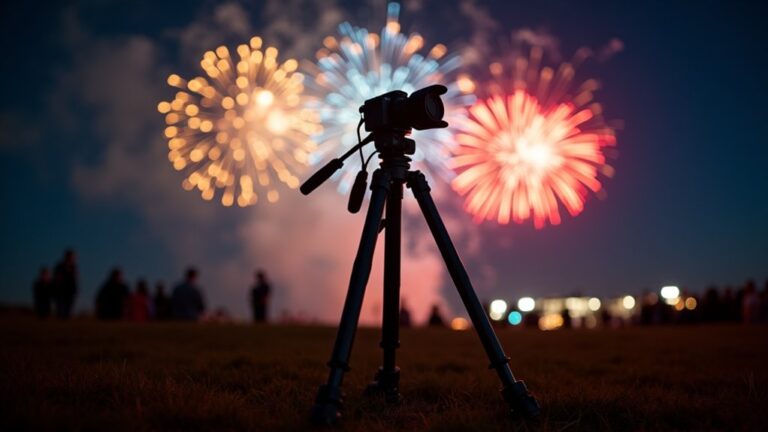
To capture sharp firework shots, use manual focus. Set your lens to infinity to ensure clarity during the display. Pre-focus before the event starts, and switch to manual mode to avoid any autofocus issues. If needed, check your focus using live view magnification. With a stable tripod and appropriate camera settings, you can achieve stunning images. Explore advanced techniques to further enhance your firework photography skills.
Key Takeaways
- Set your lens to manual focus and adjust it to the infinity mark to capture sharp firework bursts without any focus shifts.
- If your lens lacks an infinity mark, use live view magnification to focus accurately on distant fireworks.
- Pre-focus before the display starts to ensure you’re ready to capture the action without any delays.
- Always double-check your focus after taking test shots, as temperature changes can affect the infinity position.
- Consider using hyperfocal focusing to enhance depth of field, ensuring both the fireworks and any foreground elements are in sharp focus.
Understanding Manual Focus for Fireworks

When photographing fireworks, manual focus is crucial, as autofocus systems often struggle in low-light situations. Manual focus offers clear advantages; it ensures accurate focus, keeping your shots sharp despite the unpredictable movements of the fireworks. By setting your lens to infinity, you can capture the vivid bursts with most of the scene in clear detail. Furthermore, manual focus prevents unexpected shifts in focus, allowing you to maintain consistent settings throughout the display. To enhance depth of field, consider using hyperfocal focusing, which lets you include interesting foreground elements in your shots. This technique is especially effective when paired with a sturdy tripod to achieve the clarity you want during these brief moments, ensuring your images reflect the stunning beauty of the fireworks.
Preparing Your Camera for Night Photography

To capture impressive firework shots at night, prepare your camera with the right settings and equipment.
Begin by adjusting your ISO, aperture, and shutter speed for optimal exposure, and ensure your manual focus is set accurately. A simple checklist will help you gather everything needed to achieve sharp, vibrant images in low light. Additionally, using a tripod for stability will greatly enhance your ability to capture sharp images during long exposure times.
Essential Camera Settings
Preparing your camera for night photography requires adjusting key settings to improve image quality and control exposure.
Start by using Manual mode to effectively manage the exposure triangle. Set your shutter speed between 2 to 60 seconds, depending on your subject and the amount of light you want to capture.
For aperture, select a wide setting like f/2.8 to gather light quickly, or f/8 to f/16 for a greater depth of field during longer exposures.
Keep your ISO low, around 100-400 for tripod shots, to reduce noise. If it’s particularly dark, you can increase it to 1600-6400. A sturdy tripod is essential for stability during these long exposures.
Shooting in RAW format is essential for preserving quality and allows for adjustments in post-processing, enhancing your night shots.
Equipment Checklist for Success
When preparing for night photography, having the right gear is crucial for capturing stunning firework shots.
Opt for a full-frame camera like the Sony A7SIII or Nikon Z9 for excellent low-light performance. Pair it with a wide-angle lens, such as the Rokinon 14mm f/2.8, which allows for plenty of light and supports manual focus—essential for sharp images in the dark.
A sturdy tripod is a must to prevent camera shake during long exposures. Use focus aids, like magnification, to ensure precision.
Don’t forget a remote shutter release to eliminate vibrations while shooting. Lastly, bring extra batteries and memory cards to be ready for extended sessions.
With the right equipment, your photography will truly stand out.
Setting Up Your Tripod for Stability

When setting up your tripod for fireworks photography, it’s crucial to ensure maximum stability to capture sharp images during long exposures.
Opt for a sturdy tripod made from durable materials; flimsy models can lead to issues. Adjust the leg height so your camera is level with the horizon for optimal composition. Fully extend the legs for the best stability, but be mindful of your surroundings in tight spaces.
If it’s breezy, weigh down your tripod with a sandbag or your camera bag to minimise vibrations. Before you start shooting, double-check all clamps and leg adjustments to make sure everything is secure.
A solid setup is key to avoiding blurry images and capturing stunning trails of fireworks.
Choosing the Right Lens for Fireworks

Choosing the right lens for fireworks photography is crucial for capturing the spectacle effectively.
For distant shots, a telephoto lens, such as a 70-200mm or 70-300mm, offers great framing flexibility. If you’re closer to the action, a wide-angle lens, like a 15mm or 24mm, will help you capture the full scene.
Mid-range zooms, such as 18-55mm or 24-120mm, provide versatility for quick adjustments. While zoom lenses are popular for their adaptability, prime lenses like an 85mm can yield exceptional image quality.
If you’re using a crop sensor camera, remember to opt for wider angles to compensate for the crop factor.
Selecting the right lens and focal length will ensure you capture stunning fireworks displays.
Adjusting Camera Settings for Optimal Results
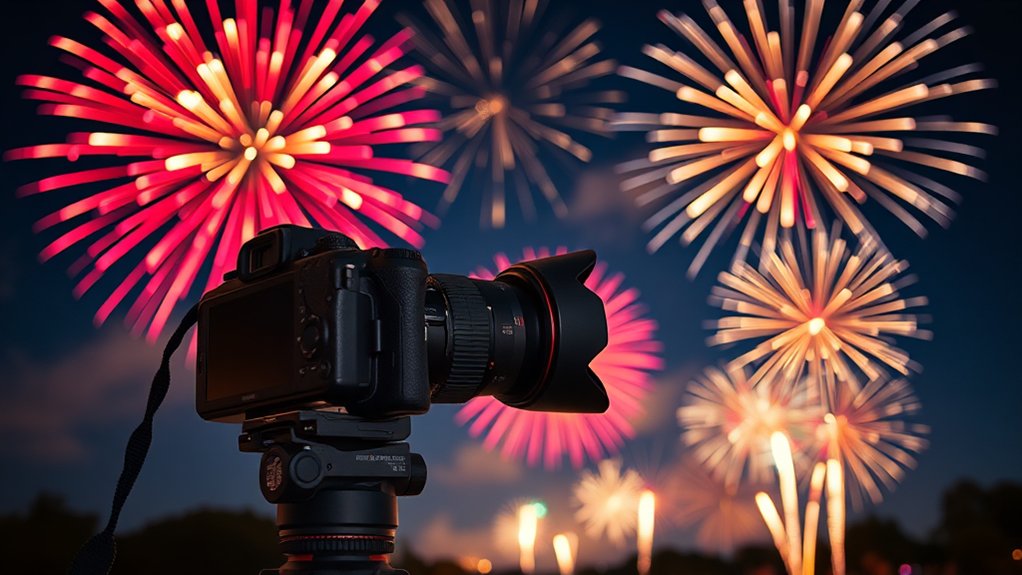
To capture impressive firework photographs, you’ll need to adjust your camera settings carefully.
Start with an ISO of 100 to 400, and set your aperture between f/8 and f/13 to enhance the vibrancy of the colours.
For the shutter speed, use a longer exposure—either the bulb mode or 3-5 seconds—to create striking light trails.
ISO and Aperture Settings
Setting the right ISO and aperture is crucial for capturing stunning fireworks photographs. Start with a low ISO, ideally between ISO 100 and 400, to reduce noise and maintain clarity against the dark night sky.
The brightness of fireworks means you won’t need high sensitivity, so keeping your ISO low helps preserve dynamic range and prevents overexposure.
For aperture, opt for a mid-range setting, typically between f/8 and f/16, to ensure sharpness and depth of field.
If your images are too bright, adjust towards f/11 or f/16. Manual adjustments to both ISO and aperture give you control over exposure, balancing sharpness and noise while optimising your camera’s performance for those spectacular bursts.
Shutter Speed Selection
Capturing fireworks requires careful shutter speed selection, alongside adjustments to ISO and aperture. Start with a 3-second exposure to fully capture a single firework explosion.
For striking light trails, extend your exposure to between 20 and 30 seconds, allowing several bursts to merge artistically. If you prefer to isolate individual bursts, use shorter shutter speeds of around 1/2 to 1 second for clarity.
It’s crucial to use manual exposure mode to prevent automatic adjustments that could misread the scene’s brightness. Consider using bulb mode with a cable release for precise timing, ensuring you capture each firework at its peak. Additionally, locking focus and exposure helps maintain consistent image quality, which is essential for stunning firework photographs.
Keep an eye on your shutter speed to avoid overexposure and loss of detail, helping you achieve stunning firework photographs.
White Balance Adjustment
While it’s easy to rely on auto white balance when photographing fireworks, manually adjusting your camera’s white balance can significantly improve colour accuracy and vibrancy. Experimenting with different settings, such as a specific Kelvin temperature, helps you control the colour temperature in your shots. Here’s a quick reference table for effective white balance settings:
| Setting | Colour Temperature | Recommended Use |
|---|---|---|
| Auto White Balance | N/A | General shooting |
| Incandescent | ~2500K | Intermediate colours |
| Daylight | ~5300K | Strong orange hues |
| Custom (Lock) | Variable | Consistent colour throughout the shoot |
| Manual Adjustment | ~9500K | Warm, reddish tones |
Using these settings will ensure your fireworks photos display the vibrant colours you intend.
Techniques for Achieving Infinity Focus

To achieve infinity focus effectively, follow these straightforward techniques to ensure distant objects are sharp and clear.
Start by switching your lens to manual focus mode to avoid the autofocus interfering with your settings. Rotate the focus ring to the ∞ position, using the distance scale for accuracy. If your lens doesn’t have a marked infinity point, use live view magnification to focus on a distant light until it appears sharp.
Pre-focus to infinity before the fireworks start, so you’re ready to capture the moment.
After taking a few test shots, double-check your focus, as changes in temperature can affect the actual infinity position. This careful manual adjustment will help you maintain sharpness across the entire sky, allowing you to capture stunning firework displays effortlessly.
Utilizing Focus Pulling for Creative Effects

When you adjust the focus during a shot, you’re using the technique known as focus pulling, which can significantly elevate your firework photography.
By shifting the point of sharpness, you can create engaging transitions that draw the viewer’s eye between elements, such as silhouetted spectators and dazzling fireworks. This focus manipulation adds depth and narrative to your images.
To achieve smooth focus pulls, practice varying your speed based on the distance of your subject and use markings on the lens for precision.
You can also experiment with rhythmically altering the focus to highlight explosive trails or sparks. By combining these methods with manual focus, you can produce striking visuals, turning standard firework displays into captivating, artistic shots.
Mastering Long Exposure Photography

Mastering long exposure photography enables you to create striking images that capture the passage of time within a single frame.
To get started, switch your DSLR or mirrorless camera to manual mode and turn off image stabilisation. A sturdy tripod is essential, and using a remote shutter release will help prevent any vibrations.
Consider employing neutral density (ND) filters to manage light intake, allowing for longer exposures even in bright conditions.
When composing your shots, pair static subjects, like buildings or trees, with dynamic elements, such as flowing water or moving clouds, to add visual interest.
Carefully adjust your shutter speed, aperture, and ISO settings, and opt to shoot in RAW format for greater editing flexibility. Incorporating firework safety measures is also vital to ensure a safe and enjoyable photographic experience during celebrations.
With practice, you’ll be able to capture breathtaking images that beautifully convey motion and atmosphere.
Tips for Reducing Camera Shake

Capturing sharp images in dynamic situations can be tricky, but reducing camera shake is key to clear photos.
Start by holding the camera firmly, keeping your arms close to your body and bending your knees for better stability. Use stabilisation techniques, like in-body stabilisation or image stabilisation lenses, to further minimise shake.
Adjust your settings to a faster shutter speed, ideally faster than 1/focal length, and opt for a wider aperture. Remember to exhale slowly as you gently press the shutter to avoid any movement.
If you don’t have a tripod, lean against a solid surface or use a monopod for extra support while shooting handheld.
Experimenting With Different Shooting Techniques

When capturing fireworks, experimenting with different shooting techniques can significantly enhance your images.
Start with classic focus methods, such as pre-focusing on a distant object and switching to manual focus to keep everything sharp. You can also try intentional focus pulling—begin out of focus, then shift to sharp focus during the burst for added impact.
Another exciting technique is zooming during exposure; adjust the zoom ring to create dynamic light streaks.
Mixing focus and zoom techniques can yield unique results. Make sure to practise these methods to build familiarity with your lens.
Each technique opens up creative possibilities, turning your fireworks photography into a true art form.
Post-Processing Fireworks Images for Enhancement

Capturing stunning fireworks images is just the beginning; post-processing is key to enhancing their visual appeal. Use software like Adobe Lightroom or Photoshop to refine your images.
Start by adjusting exposure and contrast to ensure the fireworks stand out against the dark sky. For colour enhancement, carefully boost vibrance and saturation while keeping natural tones intact. Selective colour adjustments can fine-tune specific hues of the fireworks.
Graduated filters help balance exposure, and recovering highlights alongside brightening shadows adds depth to your shots. Sharpen selectively, focusing on the fireworks while minimising noise in the darker areas.
Lastly, make any necessary crops and eliminate distractions to create a polished image ready for sharing.
Frequently Asked Questions
How Do I Choose the Best Location for Firework Photography?
To choose the best location for firework photography, prioritise safety and crowd management. Arrive early to secure a good spot, assess how busy the area is, and ensure you have an unobstructed view for the best shots. For instance, a park with a clear line of sight to the display can be ideal, while staying away from crowded streets will make it easier to capture those spectacular bursts of colour.
What Time Should I Arrive for the Best Shooting Position?
Arrive early, ideally 2-3 hours beforehand, to secure the best spot for shooting. This gives you time to manage the crowd, find a prime location, and set up your gear without interruptions. Enjoy the experience!
Can I Use a Smartphone for Capturing Fireworks Effectively?
Yes, you can capture fireworks effectively with a smartphone by tweaking some settings. Lock the exposure to prevent the bright displays from washing out your photos. Stabilise your device, perhaps by using a tripod or resting it on a flat surface. Experiment with long exposure settings for more dynamic shots. These techniques can significantly improve your fireworks photography.
How Do Weather Conditions Affect Firework Photography?
Weather conditions significantly affect firework photography. Rain can dampen fuses, leading to missed displays, while high humidity can dull the brightness and cause your lens to fog up. This can hinder your ability to capture clear and vibrant images of fireworks. For the best results, aim for dry weather with low humidity to ensure those spectacular colours and details shine through in your photographs.
What Should I Do if My Shots Come Out Too Dark?
If your shots are too dark, try adjusting your exposure settings—lower the f-stop, increase the ISO, or slow down the shutter speed. In post-processing, you can brighten the images by enhancing exposure and shadows without sacrificing detail.
Conclusion
Mastering manual focus and using the right techniques can help you capture stunning fireworks shots with clarity. For example, set your camera to a long exposure while focusing on a vibrant firework burst. This technique allows for sharp details against a beautifully blurred background. With practice, your images can elevate from ordinary to extraordinary, highlighting the intricate patterns and colours of each explosion. Follow these tips, and let your creativity shine through your night photography.