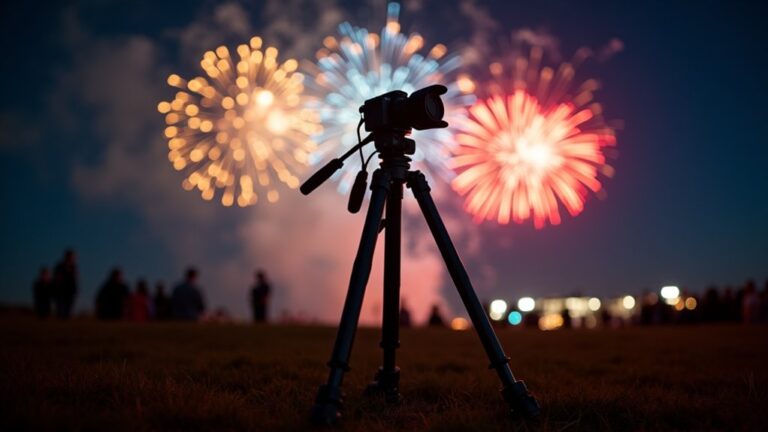
To capture stunning fireworks over water for beautiful reflections, set your ISO to 100, use a shutter speed of around 3-4 seconds, and an aperture of f/8 or f/11. A tripod is essential for stability, and make sure to set your focus to infinity manually. Position your camera low and slightly off-centre, including silhouettes in your shot for added depth. Open the shutter just before the fireworks peak, and consider using Bulb mode for longer exposures. This approach will help you create striking images—there’s much more to learn for enhancing your shots!
Key Takeaways
- Use a sturdy tripod to keep your camera steady during long exposure shots over water.
- Set your camera to manual focus at infinity for sharp fireworks images.
- Frame your shot to capture reflections and position the horizon slightly off-centre for better balance.
- Start with a 4-second exposure and adjust based on how bright the fireworks are.
- Include silhouettes of boats or people in the foreground to add depth to your composition.
Camera Settings for Optimal Fireworks Photography
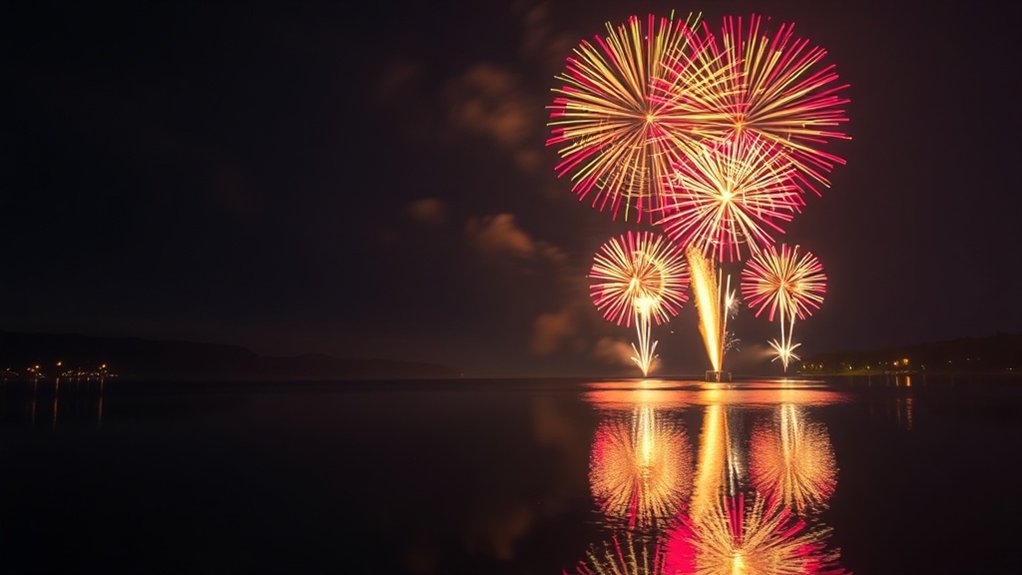
When photographing fireworks over water, setting your camera correctly is crucial for stunning results.
Start with an ISO of 100 or 125 to reduce noise and maintain sharpness. Steer clear of Auto ISO; manual settings provide better consistency. Additionally, using manual controls allows for greater flexibility in adjusting your settings based on the scene.
For shutter speed, aim for 3 to 4 seconds to capture the full trails, making adjustments if necessary. Set your aperture at f/8, narrowing to f/11 for brighter displays or widening to f/4 in low light.
Use manual focus set to infinity to ensure clarity in your images. Adjust the white balance to about 5300K for natural colours, and consider a -1.0 EV compensation to avoid blown highlights, ensuring vivid fireworks shows. Additionally, using a tripod will help achieve stability during long exposures, resulting in sharper reflections on the water’s surface.
Composition Techniques for Stunning Reflections

To capture stunning reflections in your fireworks photography, it’s crucial to consider your composition techniques. Here are some strategies to enhance your images:
- Position the fireworks off-centre, ideally in the lower third of your frame, to highlight the reflections.
- Include foreground silhouettes, such as boats or people, near the water’s edge to anchor your composition.
- Utilise negative space around reflections to accentuate the contrast between the vibrant fireworks and the calm water. Effective use of composition can significantly enhance the impact of your photographs. Additionally, consider using a sturdy tripod to maintain stability during long exposure shots, ensuring sharp images that capture both the fireworks and their reflections.
- Frame the horizon line off-centre to maintain balance and avoid a split image.
These techniques will help you create visually striking photographs that showcase both the fireworks and their reflections.
Essential Equipment for Stability and Quality

Capturing stunning fireworks over water requires the right equipment to ensure stability and image quality. Start with a robust tripod; it’s essential for preventing camera shake during long exposures. Fully extend the legs and check for stability, particularly on uneven ground. Pair this with a remote shutter release to minimise movement when photographing those impressive bursts. For added flexibility, consider a wireless option to keep your setup undisturbed. Ensure your camera supports bulb mode for longer exposures, typically between 2 to 10 seconds. With these essentials, you’ll be ready to create striking images that highlight both the fireworks and their beautiful reflections on the water. Additionally, using a DSLR or mirrorless camera will give you the manual controls needed to achieve stunning results.
Timing Your Shots for Maximum Impact
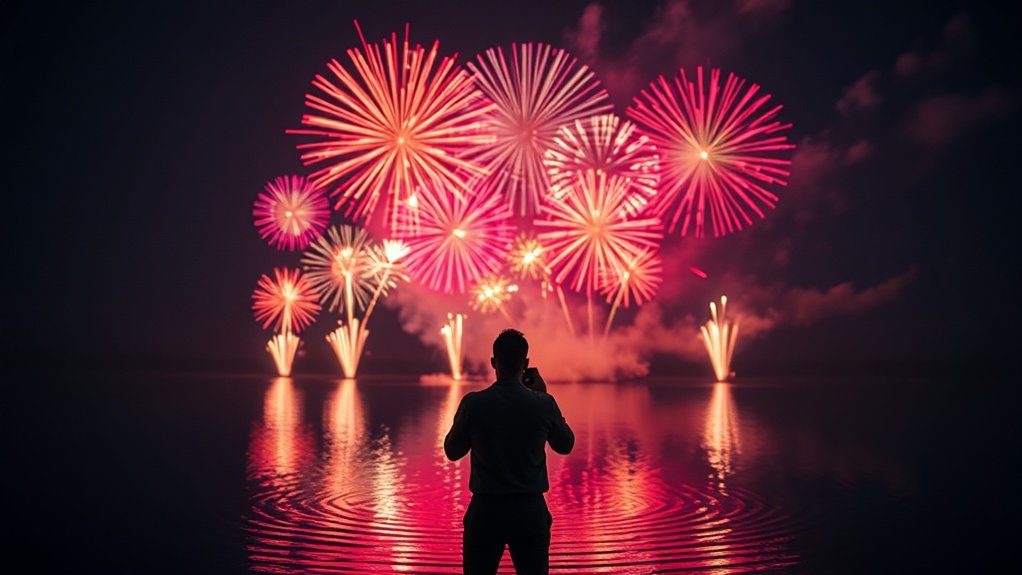
To capture stunning images of fireworks over water, timing is crucial when you press the shutter.
Here are some key tips for mastering your shots:
- Begin with a 4-second exposure and adjust according to the brightness of the fireworks.
- Open the shutter just before the fireworks reach their peak to snap vibrant bursts and their reflections.
- Use Bulb mode for longer exposures, which can create smooth reflections on the water.
- Keep an eye on environmental factors, such as wind, to ensure clarity in your images.
With these techniques, you’ll be well on your way to striking photographs of fireworks displays.
Creative Approaches to Enhance Your Images

When enhancing your fireworks images over water, think about how light and reflections can elevate your photos.
Position your camera to capture both the fireworks and their reflections, applying the rule of thirds for a balanced composition.
Try manual focus to create softer bursts of light, and use pull-focus techniques to explore textures dynamically.
Incorporate silhouettes to add depth and take advantage of calm water for clearer images.
Shooting in misty weather can introduce an ethereal quality, while adding oil to the water can create interesting patterns.
With careful composition and focus adjustments, you can transform your images into stunning visual experiences. Additionally, using a stable tripod can help maintain steadiness during long exposures, ensuring sharper reflections in your photographs.
Frequently Asked Questions
What Type of Fireworks Produces the Best Reflections on Water?
For impressive water reflections, opt for shell-based aerial fireworks such as Peony or Chrysanthemum. Their bright bursts and symmetrical shapes create striking visuals, while contrasting colours stand out against dark surfaces, resulting in beautiful mirrored images on the water.
Can I Shoot Fireworks During Windy Conditions?
You shouldn’t set off fireworks in windy conditions without following strict safety measures. Wind can change the direction of the fireworks, posing risks to spectators. Always check the wind speed and direction before planning your display to ensure safety. For instance, if the wind is blowing towards your audience, it’s best to postpone the event.
How Can I Reduce Lens Flare While Shooting?
To minimise lens flare, use a lens hood and a polarising filter. Angle your camera to avoid direct sunlight, and ensure your lens is clean for crisp, clear images.
Is It Better to Shoot in RAW or JPEG Format?
When choosing between RAW and JPEG, think about the benefits of RAW, such as better detail retention and greater editing flexibility. In contrast, JPEG has limitations like compression and a narrower dynamic range. For high-quality images, the advantages of RAW often outweigh its larger file size. For instance, if you plan to edit your photos significantly, RAW is the better option.
What Time of Year Is Best for Fireworks Photography?
The best time for fireworks photography is during summer celebrations. Events like Bonfire Night on 5th November provide vibrant displays, particularly on clear, cool evenings, making for striking visuals.
Conclusion
Capturing fireworks over water is an art, combining light and reflection. To achieve this, focus on your camera settings, composition, and timing. Use a sturdy tripod to stabilise your equipment and consider using a slow shutter speed to capture the trails of light.
Position yourself to ensure the water reflects the fireworks, creating a stunning visual effect. For example, shooting from a vantage point that overlooks a lake or river can enhance the reflections. With practice, you’ll create striking images that resonate with viewers. So, grab your gear and start capturing those spectacular moments!