

To legally run professional firework displays in the UK, you need a licence from the Health and Safety Executive (HSE) and must adhere to local council regulations. You must be at least 18 years old and hire a licensed operator. It’s also essential to have public liability insurance with a minimum coverage limit. Comprehensive safety training is required, and you’ll need to prepare proper documentation and site plans. Be ready to tackle this process to ensure your display is successful and compliant.
Key Takeaways
- To organise a professional fireworks display, you need an explosives licence from the Health and Safety Executive (HSE).
- Operators must be at least 18 years old, possess valid ID, and have prior training as assistants at fireworks displays.
- It’s essential to have public liability insurance with a minimum coverage of £1,000,000 for each incident.
- Applications for permits should include site plans and proof of insurance, and must be submitted at least 14 days before the event.
- Adhering to local regulations and having all necessary documentation, such as invoices and special use permits, is crucial for operating legally.
Federal Licensing Overview

When planning a professional firework display in the UK, understanding federal licensing is crucial for legal compliance. The relevant authority here is the Health and Safety Executive (HSE), which regulates display fireworks, distinct from consumer fireworks.
To legally use display fireworks, you must obtain an explosives licence from the HSE. This process includes thorough background checks and site inspections. A fireworks-explosives license is essential for ensuring compliance with safety regulations and legal standards. Additionally, compliance with safety standards ensures that all aspects of the display are conducted safely and responsibly.
Display fireworks are classified as explosives, and their handling, storage, and transportation must adhere to strict regulations. For instance, you’ll need to ensure that the storage facility is secure and that staff are trained in safety procedures.
Age Requirements for Firework Operators

To operate fireworks safely during a public display in the UK, you must be at least 18 years old. This age requirement ensures that you have the necessary maturity for handling fireworks responsibly. If you’re aiming to become a certified firework operator, you’ll need to provide valid identification to prove your age as part of your licensing application. Those under 18 can’t obtain an operator’s licence. Additionally, you must complete training, which includes gaining practical experience as an assistant at a minimum of three displays. These age limits are in place to promote safety and ensure skilled supervision during public events. Notably, lowering the age for fireworks display permits to 18 in Texas reflects a shift in recognizing young adults as capable of managing responsibilities in this field. Furthermore, understanding local laws regarding fireworks is essential for compliance and safety during events.
Application Process for ATF Licenses

Navigating the application process for an ATF licence can feel daunting, but breaking it down into manageable steps makes it simpler. Begin by filling out the required application forms and gathering necessary documents, such as identification and proof of qualifications. Don’t forget to pay the relevant fees when submitting your application; paying for multiple licences together can save time. Ensuring that your application is complete with all required information and signatures is crucial to avoid delays in processing the application submission.
| Step | Requirements | Timeline |
|---|---|---|
| Complete Application | Accurate information and documents | 2-4 weeks |
| Background Check | Fingerprint submission | 4-6 weeks |
| Testing | Pass required operator tests | Varies by type |
| Fee Payment | Full payment required | At submission |
Adhering to the application timeline is essential to avoid delays in receiving your licence.
Compliance With ATF Regulations

Navigating the world of professional firework displays requires strict adherence to regulations. Ensure that all staff involved in your displays receive comprehensive training to meet safety standards.
Only licensed companies are permitted to transport and handle display fireworks; improper handling can lead to serious risks. It’s crucial to follow storage and usage guidelines to ensure safety. Additionally, proper firework storage practices must be followed to mitigate risks associated with degradation and accidental ignition.
Your safety plans should include site layouts, firing procedures, and emergency protocols, all of which need to be approved by the relevant authorities.
Additionally, collaborating with local councils and emergency services is key to a successful display. By following these regulations, you’ll ensure both safety and legality in your firework operations.
State Licensing and Permitting Essentials
When planning a professional firework display in the UK, understanding licensing and permitting requirements is crucial for compliance and safety.
Each council has its own regulations regarding the application process, which typically requires submission at least 14 days prior to the event. You’ll need to provide a completed application, proof of public liability insurance, and a detailed site plan.
Permit fees can vary; for example, some councils may charge around £50, while others might be as low as £10. If your display lasts multiple days or takes place in different locations, additional permits may be necessary.
Operators must also hold the appropriate licences, with specific age and training requirements enforced by local authorities.
Don’t forget that local councils may have their own regulations, so it’s important to check both council and national requirements to avoid any complications.
Duration of State Permits
Understanding the duration of state permits is crucial for anyone planning a professional firework display. Each state has its own requirements that can significantly affect your event. Here’s a brief overview of permit durations:
- Kansas: Display operator permits are valid for four years, whereas distributor permits must be renewed each year.
- Oregon: Permits are issued for the specific date and time of your display only.
- Nebraska: Public display permits are limited to a single event date, highlighting the importance of strict compliance checks.
- Michigan: You must specify the exact time of your display to ensure safety and order.
Navigating these varying permit durations is key to staying compliant and avoiding penalties, so make sure you’re well-informed about your state’s regulations.
Components of State Permit Applications
When applying for a fireworks display permit in the UK, you need to fill out specific application forms that provide details about your event and its logistics.
This includes submitting a comprehensive site plan showing the firing location and safety zones.
You must also include proof of liability insurance to demonstrate your financial responsibility and comply with regulations.
Required Application Forms
To successfully apply for a state permit for a professional firework display, you’ll need to gather several essential application forms to ensure compliance with local regulations.
Here are the key components you must include:
- Identification and Contact Information: Provide your full name, contact details, and your pyrotechnic operator licence number.
- Insurance and Liability Documentation: Submit a current liability insurance certificate along with proof of workers’ compensation.
- Detailed Display Information: Include descriptions of the fireworks, their timing, and the maximum mortar sizes you plan to use.
- Fire Brigade Review and Authorisation: Ensure that a site inspection verification form is signed by local fire authorities.
Completing these application forms accurately is crucial for a smooth approval process, ensuring safety and compliance for your event.
Site Plans Submission
When preparing your application for a professional firework display permit, it’s crucial to submit a detailed site plan for compliance and safety.
Your site plan should clearly show the exact location of the launch site, along with safety distances from spectators, buildings, and other nearby structures. Ensure accurate measurements between mortar locations and key features like roads and water bodies.
Check that your plan meets local regulations, such as the minimum spectator distance, which can be 70 feet for each inch of shell size in some areas.
Also, include safety buffers around flammable areas and outline emergency access routes. Don’t forget that approval from the local fire department may be necessary, highlighting the importance of your site plan in the permitting process.
Liability Insurance Proof
Liability insurance proof is essential for state permit applications for professional firework displays.
Ensure you comply with the following insurance provider requirements:
- Minimum coverage limits of £1,000,000 per incident and £3,000,000 in total.
- Coverage for bodily injury and property damage specifically related to fireworks.
- Insurance for rented venues, typically at £100,000 or more.
- Prompt submission of a certificate of insurance (COI) that names all relevant parties.
It’s crucial to have these aspects in place to protect yourself and ensure a successful display.
Local Authority Approval Process
When applying for a professional firework display licence, you’ll need to submit a detailed application to your local council.
This should outline your event plans and the safety measures you intend to implement.
It’s crucial to have public liability insurance, as councils typically ask for proof of coverage and relevant professional training.
Your permit will include important details like event dates, locations, and any restrictions on the use of fireworks.
Application Submission Requirements
To obtain a fireworks licence, you need to follow a few important steps set by your local authority. Here’s what to keep in mind:
- Contact the right authority: Find your local council or the relevant department on their official website.
- Complete application forms: Fill in the forms with the details of your event, making sure everything is accurate.
- Attach documentation: Include a site map, proof of payment, and any other necessary documents.
- Adhere to application deadlines: Submit your application at least four weeks in advance to avoid any late fees.
Following these steps will help ensure a smooth application process for your fireworks display.
Insurance and Liability Criteria
Once you’ve submitted your application for a fireworks licence, the next step is securing the right insurance coverage.
Local authorities generally require public liability insurance specific to fireworks displays. This protects against claims for third-party injuries or property damage. Coverage typically starts at £1 million, but for larger events, you might want to consider higher limits.
It’s also wise to have product and equipment liability insurance. This covers any defects in the fireworks or damage to your launch equipment.
If your event is near residential areas, property damage insurance is crucial to cover potential structural damage.
Don’t forget about personal injury and medical expense coverage for attendees’ safety. Showing that you have adequate insurance during the approval process is vital for compliance and ensuring everything runs smoothly.
Event-Specific Permit Details
Securing an event-specific permit for your fireworks display is crucial to ensure compliance with local regulations and safety standards.
Here are the key steps to follow:
- Submit your written application 14-15 days before the event.
- Provide detailed information about the types of displays and their location.
- Expect inspections from fire officers and local police to ensure safety.
- Be aware of potential permit fees, which can vary widely.
Insurance and Liability Requirements

When organising a professional firework display, understanding insurance and liability requirements is essential for protecting your event and finances. You’ll need different types of insurance, including public liability and commercial vehicle insurance, to effectively manage risks. Here’s a brief overview:
| Insurance Type | Coverage Amount | Purpose |
|---|---|---|
| Public Liability | £1,000,000 – £5,000,000 | Covers bodily injury and property damage |
| Commercial Vehicle Insurance | £1,000,000 per accident | Covers vehicle-related incidents |
| Additional Insured Requirement | N/A | Protects event organisers |
| Cancellation Coverage | N/A | Protects against financial loss from cancellations |
Having adequate insurance ensures compliance with legal requirements and protects you from potential lawsuits, making it a vital aspect of effective risk management.
Safety, Storage, and Handling Regulations
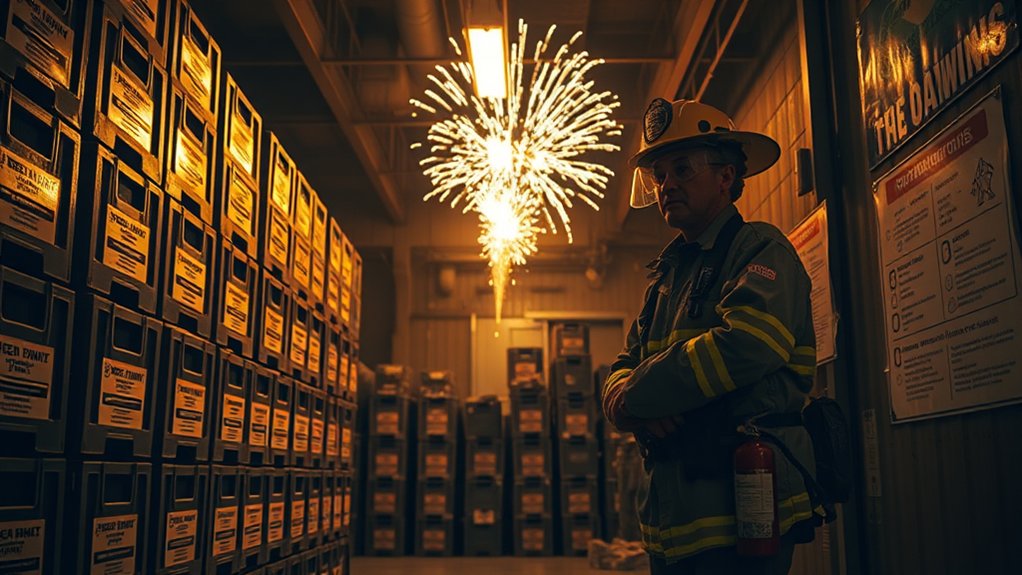
Ensuring safety during a professional firework display relies on strict compliance with storage and handling regulations.
Here are essential safety measures to follow:
- Set up a secure perimeter to keep unauthorised individuals out and maintain a safe distance for spectators.
- Store fireworks in locked, dry areas, ensuring they’re a safe distance from discharge sites.
- Only use approved mortars and racks, checking them thoroughly beforehand to ensure they’re stable.
- Limit access to the site to essential personnel only, and avoid distractions such as mobile phones near ignition zones.
Specifics and Limitations of Firework Displays
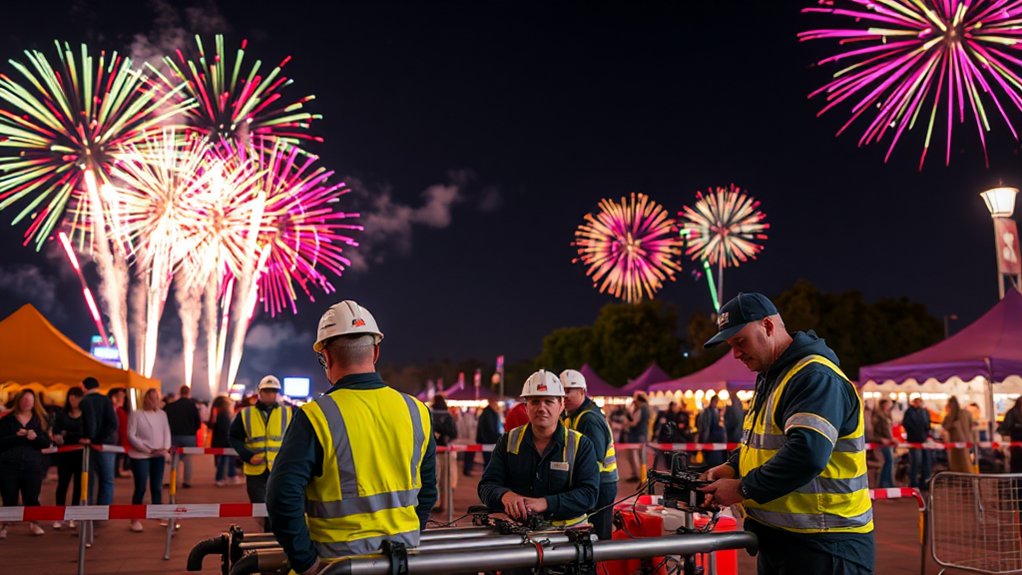
When planning your firework display, be mindful of permit validity periods, as these can vary significantly.
If you’re hosting several events, check for regulations that might affect your licensing or require additional permits.
Also, seasonal restrictions on sales can impact your ability to purchase the necessary fireworks, so stay informed to ensure compliance.
For example, if you’re planning a bonfire night event, make sure your permits are in order well in advance to avoid any last-minute issues.
Permit Validity Periods
Understanding the validity periods for permits related to professional firework displays is crucial for ensuring compliance and safety. Here are some key points to consider:
- Permits generally run from 1 January to 31 December, with some allowing a 30-day grace period after expiry.
- You should receive notifications about permit expiration at least 90 days beforehand, prompting you to start the renewal process.
- Each permit outlines specific event dates and locations, ensuring you follow safety regulations.
- Remember that permits are non-transferable and are strictly linked to the designated exhibitor.
If you miss the renewal deadline, your permit may expire, putting your display at risk.
Stay informed and act promptly to ensure your fireworks event is both compliant and impressive!
Multiple Event Regulations
Once you have secured the necessary permits for your firework displays, it’s essential to understand the specific regulations for multiple events. Each display requires individual ATF licences and approvals from local authorities, particularly if the event is on navigable waterways or near airports. Safety is crucial; therefore, adequate insurance and trained personnel must be arranged for every event.
| Requirement | Description |
|---|---|
| Licensing and Permits | Obtain ATF licences and local authority approvals. |
| Safety Measures | Ensure fire and rescue services are scheduled for each event. |
| Event Logistics | Coordinate with law enforcement for crowd management. |
Thorough planning ensures compliance with all regulations, keeping your events safe and successful.
Seasonal Sale Restrictions
Navigating seasonal sale restrictions for fireworks in the UK can be tricky, so it’s important to understand the relevant timelines and regulations. Here are some key points to keep in mind:
- Sales periods typically occur around Bonfire Night and New Year’s Eve, with specific dates varying by local council.
- Local regulations may introduce further restrictions, especially during periods of heightened fire risk.
- Only legal fireworks can be sold, usually with limitations on the types and sizes permitted.
- Retailers must keep proper documentation, such as invoices, to demonstrate lawful purchases.
Being aware of these restrictions helps ensure compliance and safety. Ignoring the rules could result in fines or legal issues, so make sure you’re well-informed before selling fireworks in your area.
Special Use Permits for Unique Situations
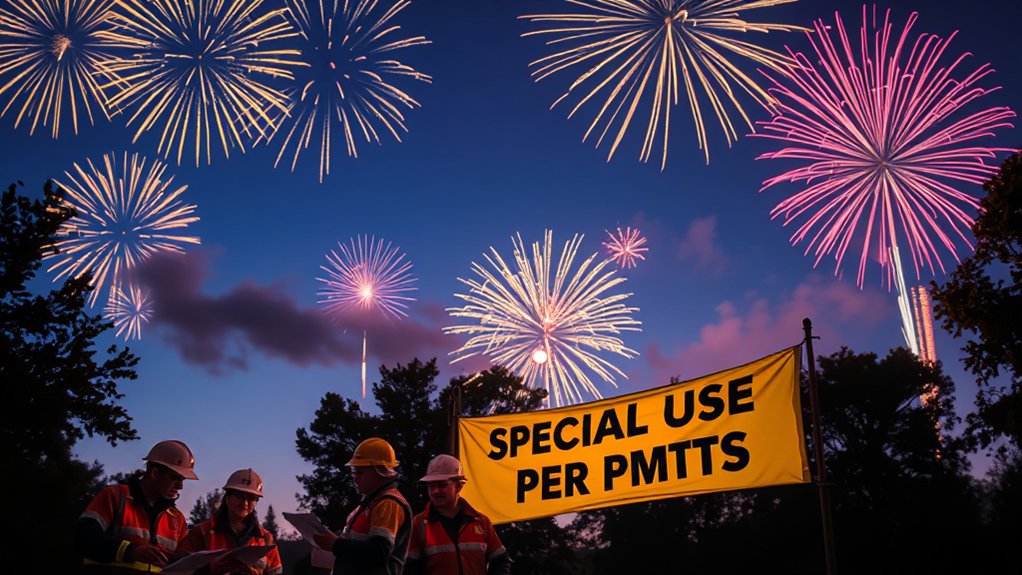
When planning a professional fireworks display in the UK, obtaining a special use permit is crucial, especially for unique situations like indoor displays or complex flame effects.
This permit ensures that you meet safety regulations and event protocols. You must submit your application at least 10 days before the event, including details about the location and safety measures.
Approval from local fire and police authorities is typically required, and you must engage a licensed operator to handle the display.
Keep in mind that the permit is non-transferable and specifically linked to your event and operator.
Frequently Asked Questions
What Are the Penalties for Operating Without Proper Licenses?
If you operate without the necessary licences, you could face serious consequences such as civil penalties, fines, and even criminal prosecution. For instance, if a food vendor fails to obtain a food hygiene certificate, they could be fined and possibly shut down. Additionally, not adhering to display regulations could compromise safety, void your insurance, and lead to further financial liabilities. It’s crucial to ensure you have the right licences to avoid these issues.
Can I Conduct a Display Without a Licensed Operator?
Conducting a firework display without a licensed operator is like walking a tightrope; one mistake can lead to disaster. Firework safety is crucial, so it’s essential to follow display regulations and ensure compliance to avoid serious consequences. Always prioritise hiring a qualified professional to handle your fireworks, as their expertise is vital for a safe and enjoyable event.
Are There Age Restrictions for Spectators at Firework Displays?
There are no specific age restrictions for spectators at firework displays in the UK. However, safety measures are in place to ensure these events are family-friendly. With crowd control barriers and security personnel, the safety of all attendees, particularly young children, is prioritised during the celebrations.
What Types of Fireworks Are Prohibited for Professional Displays?
You won’t believe the types of fireworks banned for professional displays! Safety regulations in the UK prohibit aerial shells over 60 grams, Roman candles exceeding 20 grams, and various other items that could turn a spectacular show into a hazardous situation.
How Can I Find a Licensed Firework Operator in My Area?
To locate a licensed firework operator in your area, start by checking local regulations. Speak to your local fire service and look for online directories specific to the UK. Ensure the operator prioritises safety and possesses the necessary certifications and experience to deliver a successful display.
Conclusion
In the realm of professional firework displays, navigating the maze of licences and regulations can seem daunting. However, by understanding the necessary federal and local requirements, you can create stunning shows that captivate audiences and illuminate the night sky—legally and safely. Always remember, the excitement of fireworks should never compromise compliance. So, ensure you obtain the correct licences and get ready to transform the sky into a spectacle of brilliance!


