For impressive visual effects, multi-stage rockets are ideal. Their unique flight paths offer captivating dynamics, featuring dramatic stage separations and vibrant flame displays. Cartoonish rockets also attract audiences with their exaggerated shapes and bright colours, making for smoother animations. Realistic simulations elevate these effects by accurately depicting fire, smoke, and atmospheric interactions. This combination of creativity and technical skill ensures a memorable experience. Delve deeper to discover more techniques and tools for stunning rocket visuals.
Key Takeaways
- Multi-stage rockets provide exciting visuals during stage ignitions and separations, making animations more dynamic.
- Cartoonish and stylised rockets feature exaggerated shapes and bright colours, making them instantly recognisable and appealing for various projects.
- Realistic rockets utilise physics-based simulations for accurate exhaust plumes and interactions with the atmosphere, offering immersive visual effects.
- Rockets with oversized fins and vibrant flames convey a sense of innovation, adding playful aesthetics that enhance animations and engage viewers.
- Unique engine configurations create distinctive exhaust visuals between stages, adding to the excitement of rocket animations.
Distinct Flight Profiles for Visual Clarity

As rockets ascend into the sky, their flight profiles are crucial for how spectators perceive their journey. You’ll observe distinct phases—during the thrusting phase, flames and plumes are visible as the rocket rapidly gains altitude. This striking display grabs your attention.
Following this, the coasting phase offers a smooth arc, shaped by gravity’s influence. Each transition between these phases enhances clarity, making it easier to follow the rocket’s path. Extended coasting periods create more pronounced arcs, improving readability. Additionally, the total impulse of the rocket’s motor plays a significant role in determining the duration of the thrusting phase.
While factors like variations in thrust and external winds can introduce dynamic movements, a stable design ensures a seamless experience. Ultimately, these elements craft a visually engaging narrative of the rocket’s flight.
The Appeal of Cartoonish and Stylized Rockets

Spectators are often drawn to the whimsical charm of cartoonish and stylised rockets, which contrast sharply with more realistic designs.
These cartoon rockets, featuring exaggerated shapes and bright colours, evoke nostalgia and spark imaginative exploration. Their simplified designs make them easily recognisable in animations, enhancing audience engagement. Additionally, these stylized rockets often come with lifetime commercial licenses, allowing creators to utilize them in various multimedia projects without legal concerns.
Stylised elements, such as oversized fins and vibrant flame trails, symbolise innovation and success, aligning well with branding for tech firms and startups. Their approachable nature encourages attachment, opening the door for storytelling.
Additionally, bold outlines and playful aesthetics allow for smooth animations, ensuring clarity and excitement.
Ultimately, cartoon rockets convey complex themes simply, creating memorable visual experiences that resonate across all ages.
Realistic Rocket Simulation Techniques
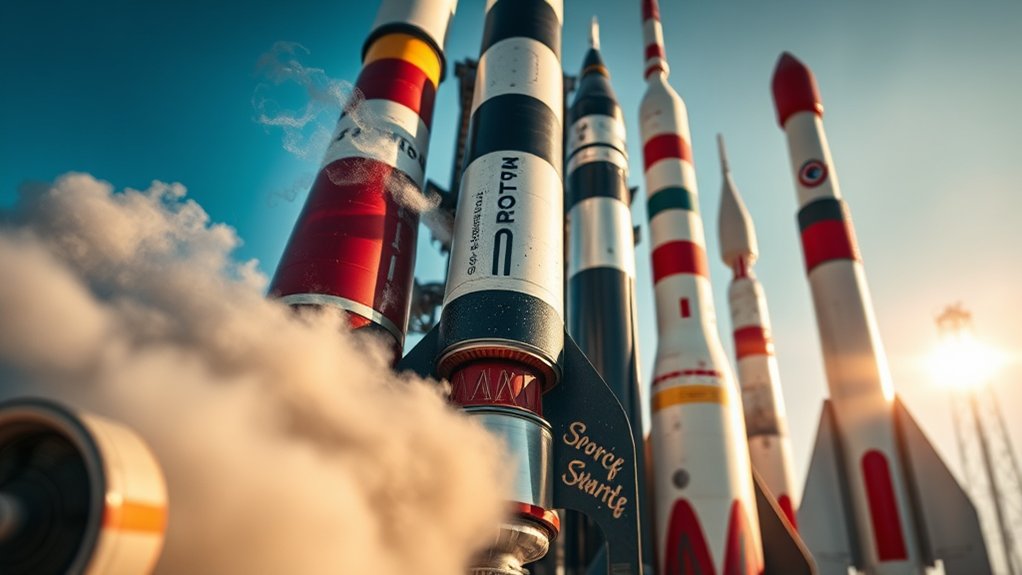
To create realistic rocket simulations, you must master physics-based particle systems that accurately represent exhaust plumes and their interactions with the atmosphere. Incorporating realistic aerodynamic simulations will improve your models, enabling them to respond to forces like drag and lift in a lifelike manner. Additionally, utilizing active control systems will enhance the accuracy of your simulations, ensuring that the rocket’s steering and stability mimic real-life behavior. With these techniques, your visual effects won’t only look impressive but also behave authentically, engaging your audience effectively.
Physics-Based Particle Systems
In simulating the intricate dynamics of rocket exhaust, physics-based particle systems are crucial for achieving realism. These systems accurately model particle interactions and effectively replicate plume behaviour, enhancing the visual effects of rocket launches. By integrating with fluid dynamics solvers, they provide a vivid representation of smoke and gas dispersion.
| Feature | Description |
|---|---|
| Particle Emitters | Produce realistic smoke plumes with specific inflow velocity. |
| GPU Acceleration | Facilitates real-time rendering of extensive particle populations. |
| Adaptive Grids | Captures multiscale behaviours, enhancing simulation accuracy. |
Exhaust Plume Dynamics
Understanding exhaust plume dynamics is crucial for realistic rocket simulations, as these plumes significantly impact vehicle performance and visual effects. Effective exhaust modelling uses chemically reacting thermodynamic models to capture the complex interactions that dictate gas behaviour.
While simplified species models can improve computational efficiency, they may sacrifice realism in chemically intricate situations.
In solid rocket motors, particle dynamics are particularly important; alumina particles influence plume opacity and flow stability. High-altitude simulations need to consider both gas species and condensed-phase particles, employing techniques like Monte Carlo ray tracing for accurate visual representation.
Striking a balance between computational costs and simulation accuracy is essential for creating stunning, realistic visual effects during rocket launches.
Realistic Aerodynamics Simulation
Realistic aerodynamics simulation is essential for accurately replicating the complexities of rocket flight, ensuring that visual effects align closely with real-world dynamics.
Tools like RASAero II allow for advanced aerodynamic modelling that takes into account factors such as surface roughness, which significantly influences drag and stability. Incorporating real-time atmospheric data improves the precision of flight predictions and adaptability.
For a practical approach, OpenRocket provides a free simulation environment, enabling you to visualise aerodynamic behaviour before conducting physical tests. Additionally, simulating control surfaces and fin deflections helps refine the rocket’s flight path, ensuring that visual effects convincingly reflect actual rocket behaviour.
This combination of techniques guarantees a more authentic representation of rocket flight.
The Complexity of Multi-Stage Rockets

When you delve into the realm of multi-stage rockets, you’ll be captivated by the striking visuals of each stage igniting and separating, producing a spectacular display of flames and smoke.
However, this complexity presents technical challenges that require precise timing and solid engineering to ensure successful stage separation.
Striking a balance between creative expression and these intricate mechanisms can feel daunting, but it’s crucial for achieving the level of realism desired in visual effects.
Visual Impact of Stages
The visual impact of multi-stage rockets during launch is truly captivating. As each stage separates, the aesthetics change dramatically. The largest first stage takes centre stage, followed by the slimmer upper stages.
When stages detach, they create explosive bursts and vibrant plumes, lighting up the sky with brilliant colours and intricate flame patterns. The synchronised stage separations and ignitions add to the excitement, transforming the launch into a stunning spectacle.
Each change in stage not only tells a story but also highlights the rocket’s advanced technology, making multi-stage launches a visual treat, far more impressive than single-stage rockets.
Technical Challenges Faced
The stunning sight of multi-stage rocket launches conceals a range of technical challenges that engineers must tackle. Each stage design incorporates detailed elements to ensure both functionality and safety.
Some of the main challenges include:
- Reliable separation mechanisms to prevent failures during stage separation.
- Propulsion issues, particularly with ignition systems that must work under various conditions.
- Guidance, Navigation, and Control (GNC) systems that need to adjust to the specific profile of each stage.
- Thermal protection to endure extreme temperature fluctuations.
- Effective propellant management to prevent cross-contamination.
Additionally, the structural integrity must withstand the immense stresses of launch, while reusability problems complicate recovery systems.
Tackling these challenges not only increases the likelihood of a successful launch but also enhances the awe-inspiring spectacle, showcasing remarkable engineering skill.
Artistic Freedom Limitations
Creating visually impressive representations of multi-stage rockets requires not just creativity but also navigating a range of technical constraints that can limit artistic expression. The intricate nature of multi-stage designs imposes several key restrictions.
| Constraint Type | Impact on Visual Effects |
|---|---|
| Stage Separation Dynamics | Complicated animations for separation effects |
| Engine Configurations | Differences in exhaust visuals between stages |
| Payload Optimisation | Proportionality restricts design options |
| Aerodynamic Stability | Limits on drastic shape alterations |
| Timing Mechanisms | Necessitates synchronised effects |
Addressing these challenges involves finding a balance between realism and creativity, often requiring compromises in visual representation to maintain accuracy.
Artistic Freedom in Rocket Design
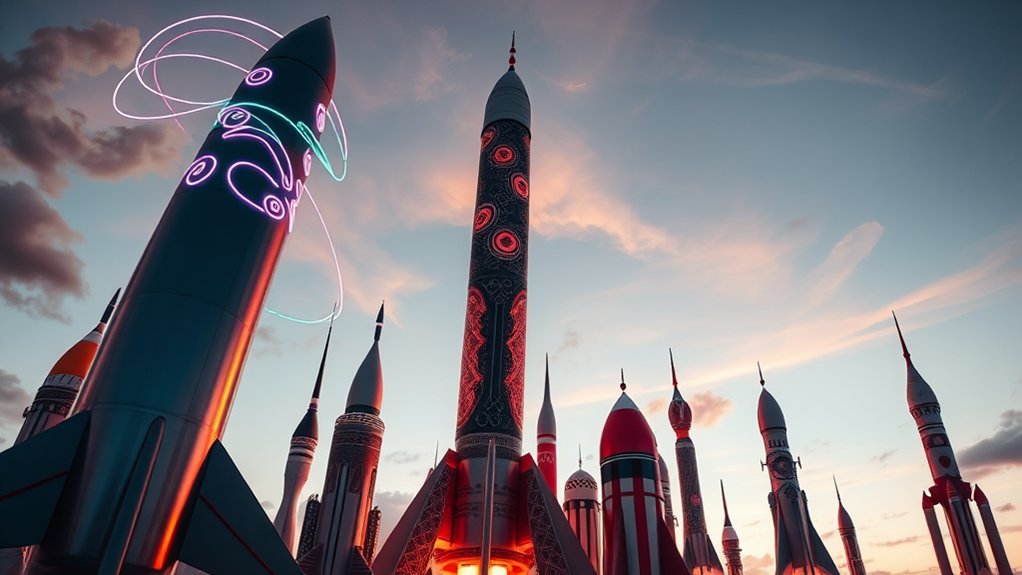
Artistic freedom in rocket design allows VFX artists to stretch their creativity, combining realism with imaginative elements to create visually captivating stories. This freedom inspires designers to explore new ideas while enhancing narrative depth.
Here are a few ways this can be achieved:
- Integrate practical features, such as drone deployment, to enrich storytelling.
- Use simulation tools for iterative design, uncovering artistic opportunities.
- Amplify shapes and textures to convey specific emotions.
- Work with experts to ensure designs are grounded in realistic physics.
- Tailor rocket components to reflect thematic elements in the narrative.
Optimal Software for Rocket Visual Effects

When creating impressive rocket visual effects, selecting the right software is crucial. Various options are available to suit different requirements, ranging from 2D designs to advanced 3D simulations. Here’s a brief comparison of popular software:
| Software | Key Features |
|---|---|
| Adobe After Effects | Excellent for 2D animation with numerous plugins |
| Blender | Free, powerful for 3D modelling and rendering |
| Cinema 4D | Ideal for dynamic simulations and integrates well with After Effects |
These tools offer motion tracking, animation capabilities, and extensive asset libraries for creative projects. Look for software with a user-friendly interface and quick rendering speeds to streamline your workflow. Features that support collaboration can also enhance team projects, particularly for complex rocket VFX.
Key Characteristics of Effective Rocket Effects

Creating impressive rocket visual effects isn’t just about the software you use; it’s about grasping the key elements that make these effects truly stand out. Here are the essentials to consider:
- Realistic flames and smoke: Use advanced fluid dynamics tools to simulate these elements accurately.
- Dynamic shadows: Ensure they integrate smoothly with real-life footage to add depth.
- Layered simulations: Combine fire, smoke, and shockwaves to amplify the overall impact.
- Gradual light buildup: Show a progressive increase in light and energy particles during the ignition and thrust phases.
- Volumetric rendering: Capture the density and variation of exhaust clouds for a more authentic look.
Workflow Best Practices for Rocket VFX Production

To ensure your rocket VFX production runs efficiently, it’s crucial to establish a clear workflow from the beginning. Prioritise workflow optimisation and effective project management to boost productivity. Start by using Nuke Studio for the streamlined ingestion of EXR frames and raw clips, which helps maintain consistent colour matching from the outset. Employ real-time engines like Unreal Engine 5 for immediate feedback, allowing for quicker iterations. Encourage collaboration across departments to align FX, animation, and lighting efforts, resulting in realistic integration. Lastly, use compositing tools to blend VFX seamlessly with live-action footage.
| Stage | Tools | Best Practices |
|---|---|---|
| Ingestion | Nuke Studio | Early colour matching |
| Real-Time Feedback | Unreal Engine 5 | Instant visual iterations |
| Collaboration | Workflow Management | Sync tasks and version control |
| Compositing | Nuke Studio | Seamless layer integration |
Frequently Asked Questions
How Do Rocket Designs Impact Audience Perception in VFX?
Rocket designs significantly influence audience perception in VFX. Detailed aesthetics improve realism, which in turn enhances viewer engagement. Unique shapes and lively animations can create emotional connections, making your visuals more impactful and immersive. For instance, a sleek, futuristic rocket can convey innovation, while a rugged, retro design might evoke nostalgia.
What Are Common Pitfalls in Rocket Effect Animation?
When animating rockets, you may encounter pitfalls such as unrealistic physics and poor animation quality. Be mindful of unnatural movements, overly complicated effects, and inconsistent lighting, as these can detract from the viewer’s experience. For instance, a rocket that wobbles erratically or has fire effects that don’t match the thrust can break immersion. Keep it simple and realistic to enhance the excitement of your visuals.
How Can Sound Design Enhance Rocket Visual Effects?
Sound design enhances rocket visual effects by layering sounds to create a realistic auditory experience. Combining engine roars, explosive sounds, and subtle ambient noises evokes strong emotions, making the audience feel more engaged. For instance, the deep rumble of a rocket engine igniting, paired with the crackle of flames, can heighten the thrill of a launch scene, ultimately enriching the cinematic experience.
What Factors Influence the Choice of Rocket Color Schemes?
When selecting rocket colour schemes, it’s important to think about colour psychology and branding strategies. High-contrast colours improve visibility, while harmonious palettes can evoke certain emotions, making your rocket stand out. For example, using bright colours like orange and blue can grab attention, while softer shades might give a more calming effect. Aim to balance aesthetics with functionality to ensure safety alongside a striking visual appeal.
How Do Cultural Influences Shape Rocket Visual Representations?
Cultural influences shape rocket visual representations through symbolic imagery and storytelling. Rockets often embody national pride and heroism, becoming powerful icons that resonate with the public. For example, the Saturn V rocket in the USA is a symbol of ambition and achievement, reflecting the country’s aspirations during the space race. Similarly, the Ariane rocket represents European collaboration and technological prowess. These visual representations not only highlight values but also inspire a sense of unity and purpose within their societies.
Conclusion
In the realm of visual effects, selecting the right rocket type is akin to picking the ideal brush for an artwork. Whether you prefer the playful appeal of stylised rockets or the striking realism of simulations, each choice influences your narrative. With the right techniques and tools, your rocket effects can do more than just look good; they can spark imaginations and make a lasting impression.